
email@email.com
On the people who leave long before they resign, what their politeness is telling you, and why noticing it early is a different skill than fixing it.
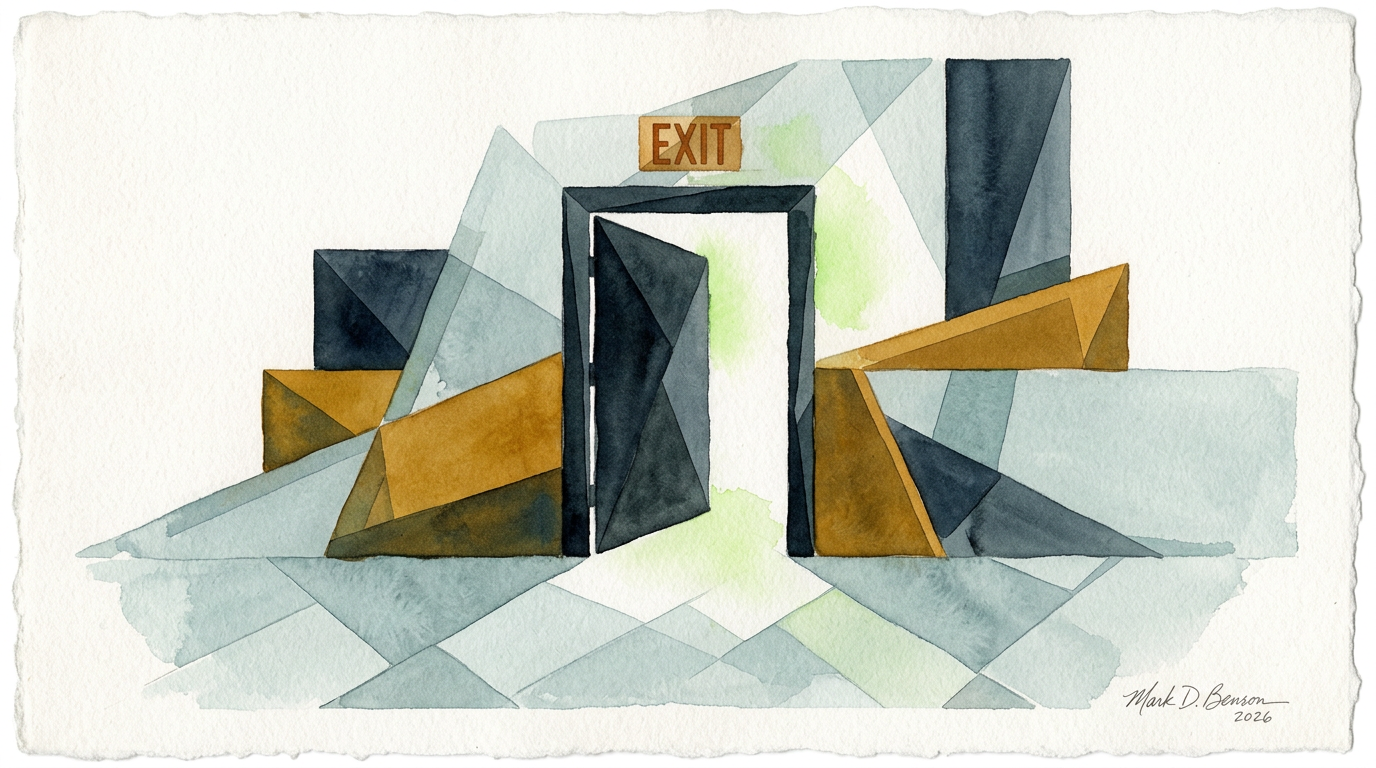
During a reorganization, a leader read the calm as a good sign. Town halls were polite, one-on-ones stayed on tasks and timelines, the dashboards were green. Then three of the strongest people left inside two quarters, each citing a great new opportunity. The exit interviews told a different story. They had stopped speaking up months earlier, after watching two hard questions get waved off in a leadership meeting. They had not gone silent because nothing was wrong. They had gone silent because they had decided that saying so would cost more than it was worth. The attrition did not begin with the resignations. It began with the first unanswered question.
Withdrawal looks like calm, which is why it is easy to miss and tempting to welcome. Under pressure, a polite, low-conflict team is not proof of trust. Sometimes it is proof that people have concluded honesty is not safe or not worth it. The dangerous case is not the person who complains. It is the person who used to push and has stopped. A voice that goes missing is the most expensive signal in the room and the cheapest to ignore.
Two things are true at once. First, the silence is information you are responsible for reading, not a betrayal to take personally. People rarely withdraw at random. They withdraw in response to something, and the something is usually nameable. Second, and harder: not every silent exit is yours to prevent, and not every one should be. Some people have outgrown the role, and the honest outcome is a good exit, not a heroic save. Some have pulled back because of a decision made above you that you cannot reverse. The skill is not keeping everyone. It is telling apart the person you are losing for no reason from the person leaving for a real one, and not flattering yourself that effort alone closes the gap.
Make it cheap to say the true thing and costly to stay silent. That is not another survey. It is what you visibly do the next time someone says something inconvenient. If a hard question gets waved off once, everyone watching files it away. So the move is small and repeated: ask the question you do not want the answer to, then reward the answer, especially when it stings. When the cause sits above you, say so plainly. Name what you can change and what you cannot, because a leader who absorbs an unfixable problem without naming it teaches the team that naming problems changes nothing.
Mark D. Benson is the founder and principal writer of Resonant Vector™, the home of Pressure Intelligence™, and the host of Pressure Rising™. He is a senior executive, product and systems leader, and writer.
In his professional role, Mark leads SmartThings at Samsung, working at the intersection of strategy, technology, and large-scale human systems. His experience spans global teams, complex platforms, and environments where sustained pressure and high stakes are the norm.
Resonant Vector™ is an independent initiative, separate from his corporate role and not affiliated with Samsung or SmartThings. It reflects a personal commitment to learning in public, sharing practical insights, and contributing to healthier leadership practice over time.
More about Mark can be found at markdbenson.com.