
email@email.com
From the reader on the ridge to the leader of an AI-speed organization: how pressure has moved through leaders and teams, and what this era asks of both.
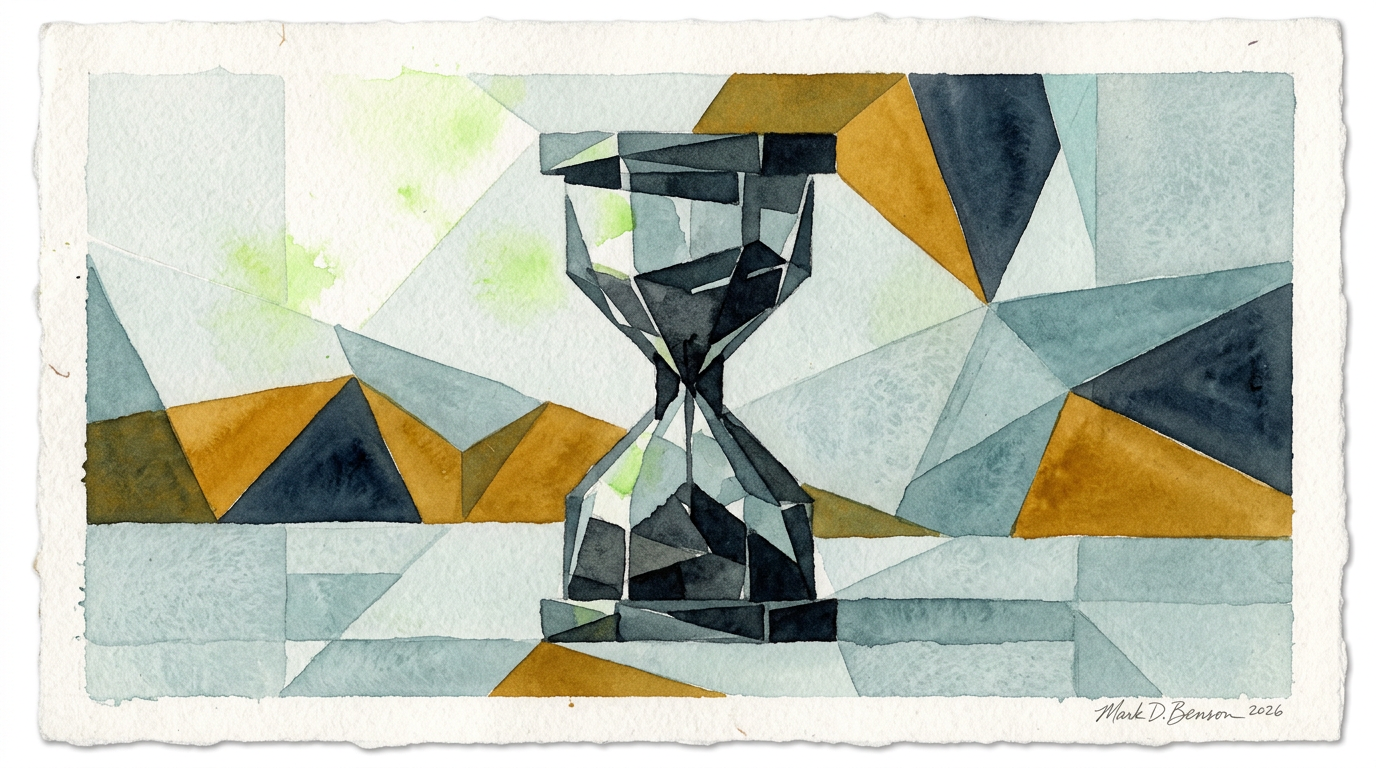
Pressure is the oldest force leaders have ever answered to, and the oldest thing teams have ever carried together. This is their history with it, and the new chapter both are living now.
Somewhere early in the human story, a woman stands on a ridge at first light, reading. The dry season has run long. The herds have shifted. There is smoke on the far horizon that was not there yesterday, and the waterhole below her has fallen to mud. She is not reading for herself. The band below the ridge will move or stay, split or hold together, based on what she says she saw, and everything pressing on their lives is present in what she can see. Her kind has been doing this for three hundred thousand years. It is, arguably, the first leadership act in the human repertoire: standing where the pressure is legible and reading it for people who cannot see it from where they stand.
Now a second reader. A leader wakes at 6:40 on a Tuesday and reaches for a glowing rectangle. Forty demands have arrived overnight from four time zones. An investor is anxious for reasons unstated. A metric has moved and nobody knows if it matters. A competitor may have shipped something, or may have only announced it. Her team will spend the day working inside whatever she decides all this means, and nothing on the screen has a horizon, a season, or a face.
Same species, same job, and to a first approximation the same nervous system, the very machinery the woman on the ridge carried. What changed, changed outside the body: the nature of the pressure that leaders read and teams carry, rewritten era after era by the ways we chose to work, and rewritten more in the last hundred and fifty years than in the previous ten thousand. This essay is the history of that rewriting, told through the two roles that have always stood at its center. Leaders are where pressure enters a human system. Teams are where it lands. Every era of this story renegotiated the terms for both.
One pattern runs through all of it, and it is worth stating before walking the arc. At every stage, we built things to relieve the pressure we had, and the things we built handed leaders and teams a new kind of pressure they did not yet know how to carry. Then, always more slowly, we invented the practices to carry it. We are, right now, deep inside one of those lags. That is not a reason for despair. It is a reason for history, because the record shows, repeatedly, how the lag closes.
Begin with the deal as evolution wrote it, because everything modern is an amendment to this contract, and no body on any team has ever signed the amendments.
For nearly all of human existence, pressure carried three properties so reliably that our biology assumed them. It had a source you could perceive: the predator, the cold, the failing waterhole. It made a demand you could act on: move, fight, store, share. And it ended. The physiology built for that world is the one Walter Cannon mapped a century ago, fight or flight, a fast, expensive mobilization wired to terminate.[1] Robert Sapolsky’s famous observation gives the design its cleanest expression: a zebra sprints from the lion, and twenty minutes later, if it is still alive, it is grazing with its stress physiology back at baseline. Zebras do not get ulcers, because zebra pressure ends. Humans became the only animal that can run the same emergency machinery for years at a time, on nothing but memory and anticipation.[2] And pressure was not only threat; it was the trainer. Scarcity taught storage, the hunt taught coordination, the cold taught planning, which is to say it taught the future. Hans Selye, who regretted naming this field stress when the physics he borrowed from would have called it strain, at least captured the doubleness: there is demand that erodes and demand that builds, running on the same machinery.[3]
Against pressure of that shape, our ancestors deployed the invention that still outperforms everything since: the group itself. The shared kill, the divided labor, the watch kept in turns, the fire circle where the day’s events were turned into common understanding.
Before any other invention, the group itself was how people carried pressure: load shared across bodies, meaning worked out together.
Agriculture wrote the first great amendment: it changed pressure’s tense. The hunter’s pressure lived in the present; the farmer’s lived in the future, the rains four months out, the seed grain that must not be eaten, the harvest whose failure kills half a year after it happens. The tools built for carrying deferred pressure are the founding artifacts of settled life: the granary, a battery for pressure; irrigation, pressure redistributed across a landscape; and administration, pressure made countable, which is why the earliest writing we possess descends from clay tokens tracking grain and rations rather than from poetry.[4] The book of Genesis preserves what may be the oldest leadership case study on record: a leader reads a warning of seven fat years and seven lean, builds storage through the abundance, and carries a nation across the famine. That an ancient people kept the story among its sacred texts tells you what settled life understood about leadership: reading the pressure signal early, and believing it, was the difference between a civilization and a ruin.
In the granary’s shadow appeared a figure this essay will follow for the rest of its length: the leader as a professional carrier of other people’s pressure. The chief, the priest, the king who answers for the rain: the first roles in which one person’s entire job was to hold, interpret, and route the pressure of many. And with that figure came the amendment’s lasting cost. For the first time, people worked under pressure whose source they could not see, the levy set in a distant capital, the war declared by someone who would never plow. Civilization begins, among other things, as a technology for moving pressure through time, and the price of admission was pressure that arrived from beyond the horizon, pre-translated by whoever stood in between.
Before the modern age, one more inheritance, because it carries the pattern that gives this history its hope: when world events subject a people to extreme and sustained pressure, their leaders eventually crystallize what the pressure taught into a tradition, a durable, portable practice that outlives the emergency.
Look at when and where the great leadership traditions actually formed. Centuries of near-continuous warfare among the states of ancient China produced the tradition assembled under Sun Tzu’s name, which treats every conflict as a problem of reading: perception, position, and timing before force.[5] Rome’s political volatility produced Stoicism’s practical flowering among leaders with real exposure, Seneca advising a tyrant, Epictetus born enslaved, and Marcus Aurelius, the most powerful man alive, writing his private exercises in carrying pressure by lamplight on a military campaign while plague burned through his empire.[6] The collapse of Roman order produced Benedict’s Rule, which answered chaos by giving a team, the monastic community, an unbreakable rhythm: fixed hours, alternating work and prayer, a schedule so stable that monasteries carried literacy itself across the centuries of fracture.[7] The Islamic tradition, forged in early persecution and exile, built sabr, steadfastness under trial, and the five daily prayers, a portable rhythm of fixed still points carried by each believer wherever the pressure finds them. Civil-war Japan drilled competence into forms that survive mortal fear. Finland’s winters and wars named sisu, the reserve beyond perceived capacity, and learned what it costs a people when its leaders budget for that reserve too long.[8]
One story compresses the whole pattern into a single act of leadership. During the Roman siege of Jerusalem, with the city starving and its fall certain, the sage Yochanan ben Zakkai had himself smuggled out, tradition records in a coffin, to stand before the Roman commander, and when offered a request he did not ask for the city. He asked for Yavneh and its sages: a school.[9] Under the most extreme pressure imaginable, he read his moment correctly: the survivable form of his civilization was not the walled place but the portable practice, and the tradition that school preserved has outlived the empire that broke the walls by nineteen centuries.
The great leadership traditions were not written in settled times. Each one records what a people learned while carrying a pressure that nearly broke them.
And the pattern carries a promise worth holding for everything that follows: the lag between a new form of pressure and the practice that answers it has been closed before, on every continent, by every people that survived long enough to do the writing.
Now the modern age proper, because it created the two figures this history has been waiting for: the manager, and the modern team.
Until the eighteenth century, work still moved to nature’s rhythms, task time, the historians call it: harvest until the harvest is in, mend nets when weather keeps the boats home. The factory broke that clock and installed its own. E. P. Thompson’s classic study documents the collision: a workforce disciplined, over about two generations and against real resistance, from task time into clock time, labor measured, bought, and supervised by the hour.[10] The mill did not care about the season. It cared about throughput, and its pressure ran at whatever pace the owner set the line. The brutality was real: fourteen-hour days, child labor, bodies consumed. But mark the structure, because the next century turns on it: industrial pressure was severe, and it was legible and bounded. The quota was a number, the foreman had a name, and when the whistle blew, the mill’s pressure physically could not follow a worker home. When labor organized against it, it could see exactly what it was fighting, hours, wages, conditions, and so the fights could be won: the eight-hour day, the weekend, the safety code. Pressure treaties, negotiated by teams acting as teams, against pressure with an address.
Then, in 1911, Frederick Taylor published The Principles of Scientific Management, and something genuinely new entered the story: pressure became a professional instrument.[11] Work was measured, decomposed, and paced on purpose, and a new occupation, management, was created to do the pacing.
After Taylor, the pressure on a team was no longer just conditions. It was a decision, made by someone whose job was to make it.
Taylor also formalized a subtler split whose consequences never stopped compounding: thinking moved to the planning office, doing stayed on the floor, and the meaning of the work began traveling separately from the work itself, the first industrial-scale version of a pattern every modern team knows, pressure arriving stripped of its reasons. Meanwhile, in a psychology laboratory in 1908, two researchers shocking dancing mice produced the finding that would be inflated into the manager’s favorite folklore: the belief that pressure is a performance dial and that turning it up is what leaders are for, a belief whose actual empirical basis, a handful of mice and no statistics, has been dismantled repeatedly without ever loosening its grip on the quarterly kickoff.[12]
The century that followed built the largest pressure-management structure in history, and then dismantled its load-bearing parts. The mid-century corporation, for all its gray-flannel conformity, offered leaders and teams something the species had rarely enjoyed: predictable pressure.[13] The career ladder made the future legible; the hierarchy functioned as a buffer, each manager absorbing the layer above, filtering what reached the team below. Then, in waves from the 1970s on, oil shocks, global competition, and the shareholder-value revolution put corporations themselves under new intensity, and they did what pressured institutions have done since the granary: passed it inward and downward. The restructuring decades, delayering, downsizing, re-engineering, performed a precise operation on the middle of every org chart: accountability stayed, control left. And science was measuring the wrongness of that operation as it happened. Robert Karasek showed in 1979 that strain is produced not by demand but by demand paired with low control; the same load with latitude produces engagement.[14] The Whitehall studies then tied low job control to nearly double the risk of coronary heart disease, while demands showed no such relationship at all.[15]
Read those findings as a leader and the verdict on the era is severe. Control is what makes pressure carryable, and the modern organization kept the load while removing the handles. At precisely the moment researchers proved which variable mattered, the corporate world was stripping that variable from every team it restructured, and it declined to act on the evidence because acting would have implicated the structure. It was cheaper to declare stress a personal problem, a move every subsequent decade has repeated with better production values.
Beneath those structural decades ran a deeper transformation, and every modern leader’s hardest blind spot descends from it: the load changed substance.
For the entire story so far, work pressed mainly on the body, and physical load has properties that shaped every leadership practice ever built. Muscular fatigue announces itself. It is visible to others, a person staggering under a sack does not need to explain the sack, and it recovers on a known schedule. Every pressure treaty humanity had negotiated, from the harvest festival to the eight-hour day, was drafted for load a leader could see.
Then, across the postwar decades, the substance changed. Peter Drucker coined knowledge worker in 1959 for the growing class whose output was thinking rather than things, and spent his last decades warning that we had almost no idea how to manage or sustain such work.[16] Manufacturing automated and shrank; services and cognition grew; and work’s load migrated from muscle to mind. The heavy thing was now attention. The strained thing was now judgment. And in a large and growing share of jobs, the managed thing was now feeling itself: Arlie Hochschild’s study of flight attendants named emotional labor for work in which the smile is a job requirement and one’s own emotional state is company product.[17]
Consider what this did to the leader’s oldest instrument, the reading. Cognitive and emotional load carries no lactic acid and leaves no mark a manager can see. A team can now be drowning in a room where nothing looks heavy. Effort became unobservable at the exact moment output became hard to measure, so organizations, needing something to manage, managed the observable: hours, presence, responsiveness, tone.
Modern work made it possible to be fully overloaded without looking overloaded, and management still mostly measures what it can see.
One more consequence hinges everything that follows. A farmer leaves the field, and the field stays. When the workplace became the mind, every member of every team began carrying the workplace home in their skull. The old edges, the whistle, the gate, the door, held by habit alone. Habit was about to meet the smartphone.
Every era so far, whatever else it changed, left pressure its edges. The horizon bounded the band’s. The season bounded the farmer’s. The whistle bounded the mill team’s, and the office door, more or less, bounded the organization man’s. Then, in the space of about fifteen years, the edges dissolved.
Email made the demand queue infinite. The BlackBerry put the queue in a pocket and gave an executive class the twitch. The smartphone, from 2007, democratized the twitch to every member of every team, and the messaging platforms that followed collapsed the last distinctions: between the colleague at the next desk and the colleague nine time zones away, between working hours and hours, between a question that needs you now and a question that merely arrived now. The pandemic completed the merger for knowledge work: when home became the office, the physical boundary, the one that had survived every previous technology, went too.
Live inside the result for a moment, because this is the texture of the modern team’s relationship with pressure. The day begins with a screen full of other people’s urgencies, read before standing up. The working hours are tiled with meetings that end where the next begins, each one’s unresolved residue carried into the next. The evening is not work and is not rest; it is monitoring, the channel open, the attention half-cocked, the body running a low idle of vigilance that Cannon’s machinery was never designed to sustain. The World Health Organization, in 2019, put burnout into its international disease classification as an occupational phenomenon, chronic workplace stress not successfully managed, which is a bureaucratic way of saying that the pressure of modern work had become distinctive enough to need its own entry in medicine’s catalog.[18]
Hold the strangeness of this squarely: by nearly every material measure, the modern worker is the safest and most prosperous in this entire story, and the strain data keeps worsening anyway. Mercer’s global surveys found the share of employees who describe themselves as thriving at work falling from 66 percent in 2024 to 44 percent two years later, a lower figure than during the pandemic itself.[19] The Occupational Safety and Health Administration reports 83 percent of American workers experiencing work-related stress, with more than half saying it reaches into their home lives, and the American Psychological Association’s Work in America survey finds a majority reporting that job insecurity alone is significantly driving their stress.[20] Most telling of all for this essay’s argument: Deloitte’s workforce research now finds that mental fatigue and cognitive strain have overtaken sheer workload volume as the leading predictors of burnout, and Microsoft’s workplace research reports a 42 percent rise in digital exhaustion, attributed not to hours but to tool sprawl and fractured workflows.[21] That last pair of findings deserves a beat, because it is the whole paradox captured in data. It is not the amount of work that is breaking teams.
Until recently, work’s pressure stopped somewhere: at a horizon, a shift whistle, an office door. For most teams today, there is no longer a place where it stops.
The treaties are being drafted anyway, right-to-disconnect laws in a growing list of countries, norms and disciplines forming team by team, and their earliness shows. We are living in the gap between a new pressure and its practice, and the gap is where the damage happens.
It is tempting to tell the modern chapter entirely from inside the team, but the organization itself is standing in its own storm, and no honest history can skip it, because the organization’s pressure is where most of every team’s pressure comes from.
The competitive clock has sped up at every level. Analyses of corporate longevity find the average tenure of companies on major indices roughly halving over a generation; the corporation that once planned in decades now defends its existence in quarters.[22] Capital moves at the speed of a portfolio rebalance. Disruption arrived as both reality and permanent atmosphere: every incumbent now operates as if a garage somewhere contains its replacement, because sometimes one does. And the modern organization lives in glass: every internal decision one forward away from public, every workplace grievance able to find an audience by evening, customers and employees and critics coordinating in the open at a speed no communications department can match.
Watch what this does through the lens this essay has been grinding since the granary: institutions under pressure pass it inward and downward, and the pressure arrives at each layer with less of its meaning attached. The board’s existential anxiety becomes the executive’s aggressive plan, becomes the director’s impossible target, becomes the team’s unexplained urgency, becomes, at the bottom of the cascade, a Tuesday-night message that reads only “need this by morning.” Nobody in that chain is villainous. Every link is doing what pressured institutions have always done. But the cascade now runs faster, through flatter organizations, with fewer buffering layers than at any point in the corporate century.
Most people in an organization never meet the market itself. They meet the version their leaders describe, and they work inside that description.
That arrangement is the hinge of this whole history, so let it carry the era’s actual stakes: the modern organization has become the conduit standing between accelerating markets and human nervous systems, and almost no one running one was ever taught that conducting pressure, deciding what it means, what to pass, and what to absorb, is among the most consequential things a leader does.
Which brings the story to the chapter being written now, in the tools this era is most proud of, and it is where the history crescendos, because every prior theme converges here at once.
For two centuries, machines relieved pressure by taking over the work of muscles, and the bargain ran in a consistent direction: the machine took the repetitive load, and people moved up a level. The automation of cognition runs the same bargain on thinking itself, and the fine print falls hardest on leaders and teams. When machine systems absorb the routine layer of knowledge work, the drafting, the summarizing, the first-pass analysis, what remains is not less pressured work but distilled pressure: the exceptions, the ambiguities, the decisions with real stakes, arriving faster because everything upstream has been accelerated. Lisanne Bainbridge saw the structure in 1983, watching industrial automation: the machine takes the easy parts, leaves the operator the hardest parts, and, by taking the easy parts, removes the daily practice that once built the operator’s skill for the hard ones.[23] Her ironies now describe every knowledge team. The contract that once took a week of specialist review is drafted by a model in an hour, and the pressure has not vanished; it has migrated into the narrowing channel where human judgment signs off, a channel already carrying nine other accelerated decisions before lunch.
As machines absorb the routine work, what remains for people is the harder share: the exceptions, the consequential decisions, and the responsibility for what the machines produce.
Organizations can now act at machine speed, ship, reprice, respond, generate, while understanding still moves at the speed of human sense-making, and the gap widens every quarter. Previous eras’ failures were mostly failures to act in time. This era’s signature failure is new: acting at full speed on a situation nobody has finished reading, with automation amplifying the unread action to scale. Above it all sits a genuinely novel condition: a growing share of the pressure on any organization now originates in systems, markets, models, feeds, that no single human fully understands. Pressure without an author, one step past pressure without an address. The financial markets previewed it on an ordinary afternoon in May 2010, when interacting trading algorithms drove American markets through a collapse and recovery of nearly a trillion dollars of value in about half an hour, faster than any human could form an opinion, let alone intervene.[24] The flash crash was contained. The condition it demonstrated was not, and versions of it now run through supply chains, media cycles, and the feeds that set the emotional weather of whole industries.
Every previous technology changed how much work a person did. This one changes how much meaning each remaining human decision has to carry. And the term sheet keeps repricing itself, because when a tool amplifies everyone, the baseline moves. Every productivity revolution in this story raised expectations until the gains were absorbed: the spreadsheet did not shorten the analyst’s week, it raised the number of scenarios a board expects to see; email did not reduce correspondence, it multiplied it. The augmented pace becomes the expected pace, now within quarters rather than generations, and the pressure to perform ratchets accordingly, not because employers grew crueler but because the possible moved, again, for everyone at once. Teams can feel the repricing as it happens: in Mercer’s data, the share of employees worried about losing their jobs to AI jumped from 28 percent to 40 percent in two years, and a worry like that does not stay parked at home. It rides into the workday as a second, unspoken workload: proving, continuously, that the human is still worth the seat.[25]
Alongside the ratchet comes a pressure with no precedent anywhere in this history: the pressure of discernment. In every previous era, whatever else was illegible about pressure, the world itself could be taken at face value; the confusion was about what the signal meant, never about whether the signal existed. That floor is now moving. Is the voice on the phone the customer, or a synthesis of the customer? Is the confident analysis grounded, or fluently invented? Was this memo written by my colleague, or produced for my colleague, and does the difference matter, and when? What in this workflow is autonomous and what is guided, and who is accountable for the part in between? Each question is small. Their sum is a new standing tax on every act of teamwork: the cost of verifying what previous generations could simply trust.
Earlier generations had to work out what a signal meant. This one also has to work out whether the signal is real.
History does offer counsel against the most obvious dread, and it comes from an unexpected corner of economics. In 1865, William Stanley Jevons observed that more efficient steam engines had not reduced Britain’s coal consumption but exploded it: efficiency made coal-powered work so much cheaper that people found vastly more uses for it.[26] My friend Scott Nelson has been making the same point about AI for several years: the instinct says these tools will take the jobs, but Jevons’s paradox predicts something counterintuitive, that tools this productive expand what gets attempted, creating more work, more jobs, and more output, not less. I find the argument persuasive, and it is worth noticing what it implies for this essay’s subject. If Jevons holds for cognition the way it held for coal, the future of knowledge work is not empty desks. It is fuller ones, doing more ambitious work at higher stakes, which means the pressure story of the AI era is not a story about work disappearing. It is a story about work intensifying, and the reading skills this whole history has been circling become more decisive for leaders, not less.
And the deepest historical rhyme is the one to hold as this chapter accelerates. Every transition in this story produced three things at once: adapters who changed faster than anyone predicted, innovators who answered the new pressure in ways nobody saw coming, and casualties, the handloom weavers, the displaced clerks, the people and places the transition marginalized while it enriched others. Which of those three a given person or team or company becomes has never been fate. It has been the sum of choices made under pressure, by leaders who held responsibility and either read their moment or misread it. Systems under pressure fracture or forge; the AI era will do both, at scale, and nothing about the distribution is predetermined. The future history of pressure has not been written. Leaders are the ones holding the pen, and what this era is doing to knowledge work deserves a fuller reckoning than a history can give it, one this library will take up on its own terms.
Stand back now and read the arc at once, because seen end to end it says something none of its chapters says alone.
The machinery has never changed. The reader on the ridge and the reader with the phone run the same physiology, built for pressure that is sourced, actionable, and finite, and a century of science has confirmed the design in ever-finer detail: the cost of pressure tracks not its magnitude but its interpretability, whether it can be controlled, whether it is judged, whether it ever ends.[27] What has changed, relentlessly and with terrific acceleration in the modern age, is the pressure’s shape, and always in one direction: away from the visible and episodic, toward the institutional, the ambient, and the authorless. Each step of that migration was the price of something we rightly wanted: food security, productivity, connection, intelligence on tap. And each step opened a lag between the new pressure and the practice for carrying it, a lag that every prior generation of leaders eventually closed with an invention: the band, the granary, the Rule, the argument, the eight-hour day, the weekend.
So the question of our chapter is not whether the current pressure is survivable. Leaders and teams have renegotiated harder terms than these. The question is how quickly the renegotiating happens, and who leads it, because the lag is where the damage lives: in the burned-out cohort, the broken team, the organization executing a misreading at machine speed.
New forms of pressure have always arrived ahead of the practices for carrying them. Closing that gap has been the recurring work of leadership.
The practices for this era are being worked out now, in companies and research labs and a great many private struggles, the same way the Rule was worked out amid collapse and the labor treaties were worked out on factory floors. The discipline I have spent recent years assembling, Pressure Intelligence™, is one contribution to that larger project: relearning, with modern tools and modern evidence, the skill the woman on the ridge would have considered too obvious to name, reading pressure as the signal it has always been, for the people who cannot see it from where they stand.
Because that is the final thing the long view offers, and it is close to consolation. Pressure has been the harshest teacher leaders and teams have ever had and, read rightly, the most reliable one. It taught us fire, storage, cooperation, law, rhythm, and rest. It is trying to teach us something now, about attention, about meaning, about the difference between speed and understanding. The oldest competence of leadership is listening to it. The next era of work will belong, as every era finally has, to the leaders and teams who relearn that listening first.
Walter B. Cannon, Bodily Changes in Pain, Hunger, Fear and Rage (New York: D. Appleton, 1915). ↩︎
Robert M. Sapolsky, Why Zebras Don’t Get Ulcers (New York: W. H. Freeman, 1994). ↩︎
Hans Selye, “A Syndrome Produced by Diverse Nocuous Agents,” Nature 138 (1936): 32. On Selye’s regret over the stress/strain naming, see the accounts collected by Paul J. Rosch of the American Institute of Stress. ↩︎
Denise Schmandt-Besserat, Before Writing: From Counting to Cuneiform (Austin: University of Texas Press, 1992); on the early grain states’ organization around what could be counted and stored, James C. Scott, Against the Grain (New Haven: Yale University Press, 2017). ↩︎
The Art of War, traditionally attributed to Sun Tzu, took shape during China’s Warring States period (fifth to third centuries BCE). ↩︎
Marcus Aurelius, Meditations, composed in Greek during his Danubian campaigns, c. 170–180 CE, amid the Antonine plague. ↩︎
The Rule of St. Benedict, c. 530 CE. ↩︎
Emilia Lahti, “Embodied Fortitude: An Introduction to the Finnish Construct of Sisu,” International Journal of Wellbeing 9, no. 1 (2019): 61–82, including the construct’s harmful register when overused. ↩︎
The account is preserved in the Babylonian Talmud, Gittin 56a–b. ↩︎
E. P. Thompson, “Time, Work-Discipline, and Industrial Capitalism,” Past & Present 38 (1967): 56–97. ↩︎
Frederick Winslow Taylor, The Principles of Scientific Management (New York: Harper & Brothers, 1911). ↩︎
Robert M. Yerkes and John D. Dodson, “The Relation of Strength of Stimulus to Rapidity of Habit-Formation,” Journal of Comparative Neurology and Psychology 18 (1908): 459–482; on the finding’s thin base and extraordinary afterlife, Karl Halvor Teigen, “Yerkes-Dodson: A Law for All Seasons,” Theory & Psychology 4, no. 4 (1994): 525–547. ↩︎
William H. Whyte, The Organization Man (New York: Simon & Schuster, 1956). ↩︎
Robert A. Karasek Jr., “Job Demands, Job Decision Latitude, and Mental Strain: Implications for Job Redesign,” Administrative Science Quarterly 24, no. 2 (1979): 285–308. ↩︎
Hans Bosma, Michael G. Marmot, Harry Hemingway, Amanda C. Nicholson, Eric Brunner, and Stephen A. Stansfeld, “Low Job Control and Risk of Coronary Heart Disease in Whitehall II (Prospective Cohort) Study,” BMJ 314, no. 7080 (1997): 558–565. ↩︎
Peter F. Drucker, Landmarks of Tomorrow (New York: Harper, 1959); and “Knowledge-Worker Productivity: The Biggest Challenge,” California Management Review 41, no. 2 (1999): 79–94. ↩︎
Arlie Russell Hochschild, The Managed Heart: Commercialization of Human Feeling (Berkeley: University of California Press, 1983). ↩︎
World Health Organization, ICD-11 (2019), QD85, classifying burnout as an occupational phenomenon resulting from chronic workplace stress that has not been successfully managed. ↩︎
Mercer, Global Talent Trends 2026, drawn from a survey of nearly twelve thousand executives, HR leaders, employees, and investors. ↩︎
Occupational Safety and Health Administration, workplace stress data; American Psychological Association, 2024 Work in America survey. ↩︎
Deloitte, 2025 Workforce Intelligence Report; Microsoft, 2025 Work Trend Index. ↩︎
Innosight’s periodic Corporate Longevity Forecast analyses of S&P 500 company tenure document the compression; the direction of the trend, rather than any precise figure, is the point here. ↩︎
Lisanne Bainbridge, “Ironies of Automation,” Automatica 19, no. 6 (1983): 775–779. ↩︎
U.S. Commodity Futures Trading Commission and U.S. Securities and Exchange Commission, Findings Regarding the Market Events of May 6, 2010 (September 30, 2010). ↩︎
Mercer, Global Talent Trends 2026; the prior-year comparison figure is from the same research program’s 2024 edition. ↩︎
William Stanley Jevons, The Coal Question (London: Macmillan, 1865). ↩︎
The convergence is summarized most sharply in Sally S. Dickerson and Margaret E. Kemeny, “Acute Stressors and Cortisol Responses: A Theoretical Integration and Synthesis of Laboratory Research,” Psychological Bulletin 130, no. 3 (2004): 355–391, and Bruce S. McEwen, “Protective and Damaging Effects of Stress Mediators,” New England Journal of Medicine 338, no. 3 (1998): 171–179. ↩︎
Mark D. Benson is the founder and principal writer of Resonant Vector™, the home of Pressure Intelligence™, and the host of Pressure Rising™. He is a senior executive, product and systems leader, and writer.
In his professional role, Mark leads SmartThings at Samsung, working at the intersection of strategy, technology, and large-scale human systems. His experience spans global teams, complex platforms, and environments where sustained pressure and high stakes are the norm.
Resonant Vector™ is an independent initiative, separate from his corporate role and not affiliated with Samsung or SmartThings. It reflects a personal commitment to learning in public, sharing practical insights, and contributing to healthier leadership practice over time.
More about Mark can be found at markdbenson.com.