
email@email.com
Six steps for talking about pressure before it becomes a conversation about blame.
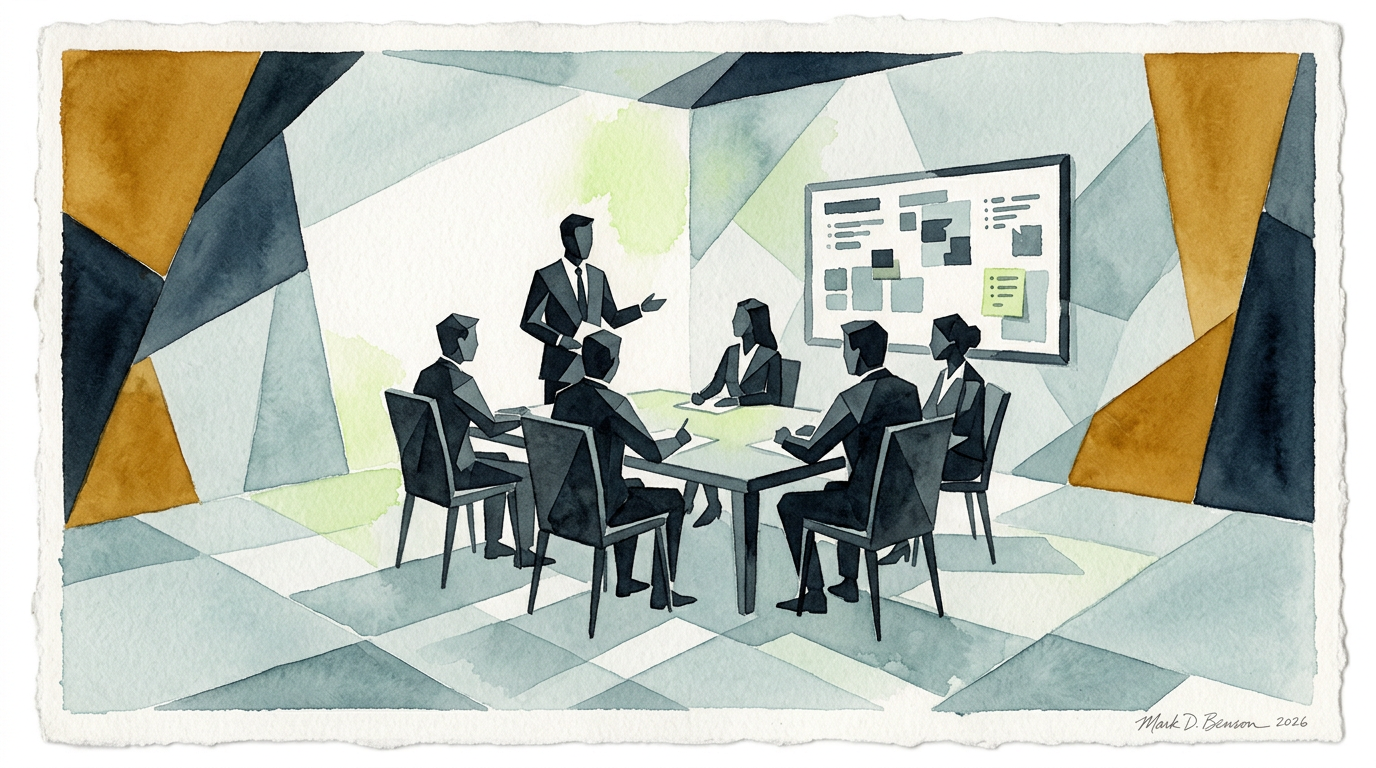
A facilitation guide for leaders running structured conversations about pressure with their teams.
Most teams never talk about pressure until the conversation is actually about blame. Something ships late or someone resigns, the retrospective convenes, and the pressure that had been building for two quarters finally gets discussed, in the worst possible frame, with everyone defending their corner of it.
By then the useful moment has passed. Unexamined pressure narrows thinking, distorts incentives, and erodes trust before anyone names what is happening, and the erosion runs on a schedule: behavior changes first, results hold for a while, then results move and the blame conversation starts. The window for the useful version of the conversation is the stretch where behavior has changed and results have not, which is precisely when nothing appears to be wrong and nobody sees a reason to meet.
Three failure modes account for most of it, and knowing them in advance is most of the defense.
It becomes a complaint session. Pressure is personal before it is structural, so the first things said will be about workload and tiredness. A facilitator who lets the conversation stay there gets a vent, which feels productive for an hour and changes nothing, because nothing structural was ever named. The move is to treat complaints as data about the system and keep asking what the pressure is doing to behavior, not just how it feels.
It becomes a performance review. The fastest way to end honest discussion of pressure is for anyone in the room to suspect their answer will follow them. One question that lands as evaluation converts every subsequent answer into positioning, and the meeting is over even though it continues for another forty minutes.
The leader defends. Somebody eventually says that a pressure the leader created is part of the problem, because it usually is. What the leader does in the following ten seconds decides whether the team ever tells the truth in this format again. Explaining why the pressure exists is defending, even when the explanation is accurate. The information was expensive for that person to hand you. Take it.
That third one is why this conversation asks for presence rather than control, and why the preparation is mostly the leader’s own. Three questions to answer candidly before scheduling anything: am I willing to hear things that challenge my assumptions, can I listen without explaining or defending, and am I open to seeing how the pressure I am carrying is shaping others. A no on any of them means pause. Run this conversation before you are ready to hear the answers and you will teach the team the topic is not safe, which costs more than never raising it.
Not consensus, and not comfort. The goal is a shared, specific picture of what pressure is doing to the team’s behavior, sorted into three categories that get treated differently: pressure that should be reduced because it harms clarity or trust without buying anything, tension that should be normalized because the discomfort is producing better decisions, and pressure that should be elevated because it aligns effort around what actually matters.
That sorting is the whole engine. A team that skips it either vents without changing anything, or tries to remove all pressure at once, which strips out the productive tension along with the harmful load and leaves the team more comfortable and less effective.
Done well, the session ends with three sentences completed as a group, each with an owner and a timeframe: one pressure to reduce, one tension to normalize, one pressure to elevate. Small, owned adjustments, because those compound and grand resets do not.
A group of four to twelve, sixty to seventy-five minutes, and in person if you can get it. A short note sent in advance, so people arrive having reflected instead of reacting in the room, stating plainly that this is not a performance review and not a problem-solving session, and asking for observations rather than conclusions.
The full facilitation guide behind the wall walks the six steps in order: the framing language to open with, the low-threat observation questions that start the room talking, the questions that move from description to impact, the naming of accepted costs, the three-category sort with the prompts for each, and the close. The steps are sequenced the way they are because each one earns the next; run the impact questions before the observation questions and the room goes defensive, run the sort before the costs are named and it stays abstract.
Free, no card. Includes the weekly Pressure Pattern.
Open directly. Something close to this:
I want us to talk about how pressure is showing up for us as a team. This is not about blame or performance. It is about understanding how pressure is shaping our behavior and decisions, so we can work more effectively.
Then set expectations: speak from experience rather than theory, no fixing in the moment, curiosity over certainty. The goal is clarity, not consensus.
Begin somewhere low threat, with questions that ask for description rather than judgment. Pick one or two:
Listen for patterns, not complaints.
Now ask what the pressure is actually doing:
Then go one layer deeper. Which of these patterns genuinely help in the short term? Which ones may be misfiring now? And the question underneath all of them: what is pressure optimizing us for, whether or not anyone chose it?
Pressure always has consequences. Ask what current pressure is costing decision quality, trust, learning, and people’s ability to bring their full value forward.
Then ask the harder version: which of those costs are we currently accepting because addressing them would be inconvenient or risky? Pressure shapes what feels acceptable, which is why the accepted costs are the ones worth surfacing.
This is the turn in the conversation, and it works only if the three categories stay distinct.
Unnecessary or unhealthy pressure. Which pressures are clearly harming clarity, health or trust? Where is pressure accumulating without improving outcomes? What exists only because of misalignment, unclear ownership or delayed decisions? These should be reduced or removed.
Productive tension. Which tensions feel uncomfortable but produce better decisions? Where is the team avoiding healthy disagreement or a real tradeoff? What needs more daylight rather than less? These should be recognized and normalized, not smoothed over.
Catalytic pressure. Where does pressure genuinely clarify priorities? What aligns effort around what matters? What helps the team make better choices rather than merely faster ones? This should be elevated and centered. Catalytic pressure is usually pointing at something: a value that matters, a decision that needs an owner, a tradeoff that has to be named, or a mission that deserves focus.
Finish by completing three sentences as a group:
Give each an owner and a timeframe. Small adjustments compound.
Pressure is unavoidable in meaningful work. The real question is whether it shapes the team without anyone choosing it, or whether the team shapes it with intent. Teams that learn to reduce what harms, normalize what sharpens and elevate what transforms do not only perform better. They tend to become more resilient, more aligned and more human under pressure.
Mark D. Benson is the founder and principal writer of Resonant Vector™, the home of Pressure Intelligence™, and the host of Pressure Rising™. He is a senior executive, product and systems leader, and writer.
In his professional role, Mark leads SmartThings at Samsung, working at the intersection of strategy, technology, and large-scale human systems. His experience spans global teams, complex platforms, and environments where sustained pressure and high stakes are the norm.
Resonant Vector™ is an independent initiative, separate from his corporate role and not affiliated with Samsung or SmartThings. It reflects a personal commitment to learning in public, sharing practical insights, and contributing to healthier leadership practice over time.
More about Mark can be found at markdbenson.com.