
email@email.com
Resilience keeps people in the game. It does not tell anyone what game they are in, and that gap is where organizations get hurt.
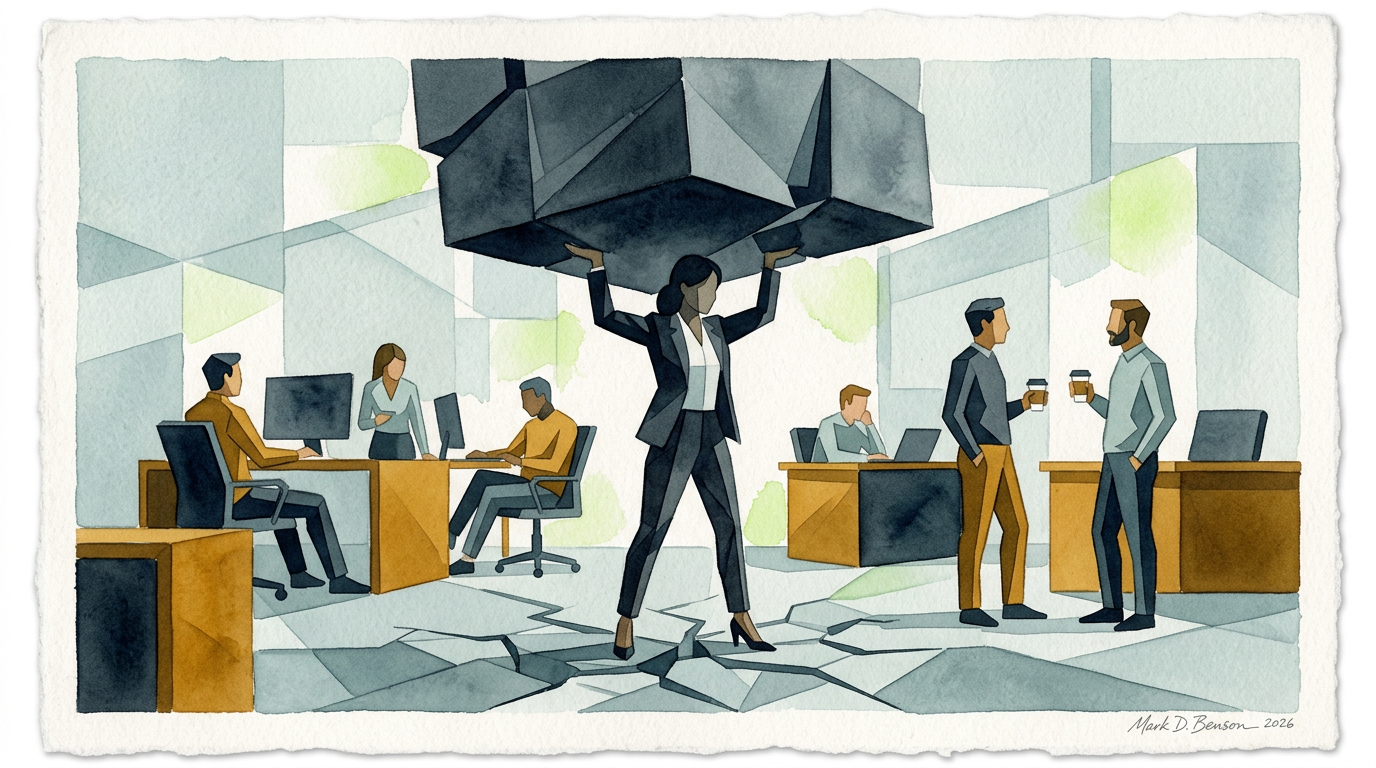
The modern workplace has one default answer to strain: strengthen the people. The evidence says resilience training delivers modest, fading gains, and that heavy reliance on endurance has a side effect nobody budgets for. Absorbed pressure stops being information, and what stops being information stops getting fixed.
Somewhere in your organization, probably this quarter, someone proposed resilience training. It is the modern workplace’s reflexive answer to strain, and the reflex is understandable. The strain is real, the budget for structural change is not, and resilience programs are concrete, purchasable, and kind in spirit. Nobody buys them cynically. I have approved them myself.
This essay is not an argument against resilience. Endurance is a real capacity, unevenly distributed, genuinely trainable at the margins, and there are seasons of organizational life that cannot be survived without it. The argument is narrower and, I think, more consequential: resilience answers the question “how do we withstand this pressure” while leaving untouched the question “what is this pressure telling us.” An organization that funds the first question and never asks the second is not managing pressure. It is muffling it. And muffled pressure does not go away. It goes underground, where it compounds.
Everyone who has worked inside a large organization knows the lifecycle. The program launches with an executive sponsor and a workbook. The sessions are actually pretty good: people learn reframing skills, they feel cared for, a few genuinely sleep better. Then the quarter ends, the facilitators leave, and six months later the same team is standing at the same wall, coping somewhat more gracefully on the way to it. Nobody audits the gap between what was promised and what stayed, because by then there is a new program.
When researchers finally counted, the count matched the lifecycle. The largest workplace test of resilience-building ever run was the U.S. Army’s Comprehensive Soldier Fitness program, which from 2009 onward put master resilience training in front of over a million soldiers, at a cost in the hundreds of millions of dollars. Corporate programs followed the same playbook at smaller scale: cognitive reframing skills, optimism habits, stress inoculation, delivered in workshops.
The meta-analytic picture on such programs is consistent. A 2016 review in the Journal of Occupational and Organizational Psychology examined workplace resilience-building programs and found a small positive effect overall, with the benefit diminishing over time after the intervention ended.[1] A 2018 systematic review in BMJ Open reached a similar verdict on resilience training generally: modest effects, wide variation, and limited evidence about durability.[2]
Small, real, fading. That is not nothing, and for people in acutely demanding roles it can matter. But notice the shape of the intervention: it upgrades the individual’s capacity to process a load while treating the load itself as fixed, exogenous, and uninteresting. Every hour of a resilience workshop carries an unstated premise: the pressure is weather. Dress for it.
Sometimes pressure is weather. A market turns, a pandemic lands, a customer fails, and the only honest move is to hold on. The trouble begins when the weather framing gets applied to pressure that is not weather at all but feedback, produced by the organization’s own decisions, aimed at specific fixable causes, and arriving with information attached. Treating feedback as weather does not just waste the information. It trains everyone to stop noticing that information was ever there.
Here is the mechanism that makes over-reliance on endurance expensive, and it is better documented than most leadership claims.
Diane Vaughan’s reconstruction of the Challenger launch decision remains the definitive study of how a technical organization came to accept, flight after flight, O-ring damage that its own engineers had originally classified as unacceptable. Her finding was not that NASA stopped caring. It was that each successful flight with damage recalibrated what counted as normal, a process she named the normalization of deviance: the anomaly gets absorbed, the absorption gets rewarded with a good outcome, and the standard moves without anyone deciding to move it.[3]
Substitute organizational strain for O-ring damage and the mechanism transfers intact. A team absorbs an unreasonable integration timeline and ships anyway. The absorption succeeds, which files the timeline under achievable. Next quarter’s timeline is built on that filing. A support group carries a broken escalation process by heroics, and the heroics hold, so the process is never rebuilt, so the heroics become the process. Every act of successful endurance under a fixable pressure ratifies the thing that should have been fixed.
The ratification happens without announcement, which is exactly why leaders miss it. Nothing in the dashboard distinguishes a team that is thriving from a team that is absorbing at its limit, because absorption is specifically the art of keeping the dashboard green.
And the more resilient the people, the longer the ratification can run before anything visible breaks. This is the perverse part. Endurance capacity determines how much unread pressure a system can accumulate. An organization of fragile people discovers its structural problems early and cheaply, because things snap while they are still small. An organization of tough ones discovers them late and expensively, at the scale the toughness made possible. Endurance, admired long enough, becomes the reason nothing changes.
Albert Hirschman gave us the classic frame for what people do inside a deteriorating institution: they exit, or they use voice, or loyalty holds them in place while they wait.[4] Absorption is loyalty’s working uniform. The person who carries a broken process without complaint is being loyal, usually admirably so. But every unit of pressure absorbed in loyalty is a unit withheld from voice. It is testimony that never gets delivered, about a defect someone upstream could have repaired.
Run that forward a few years and you get a selection effect. The people most sensitive to structural problems, the ones who feel the friction first and say so, read the culture’s real preferences and either adapt into silence or leave. The high absorbers stay, get promoted, and hire in their own image, because absorption is what the culture measurably rewards. The organization becomes progressively more resilient and progressively less informed, and the two trends are not a coincidence. They are the same trend, seen from opposite sides.
By the time the accumulated load produces a visible failure, a departure wave, a quality collapse, an integrity scandal, leadership is sincerely surprised. Of course it is. The instrumentation that would have shown the buildup was the discomfort of its own people, and the culture had spent years teaching people to process that discomfort privately, as a personal development goal.
There is a body of research that seems, at first glance, to contradict everything above: the study of high reliability organizations, the aircraft carriers, nuclear plants, and air traffic control centers that operate under extreme, continuous pressure with failure rates far below what standard organizational theory would predict. These are routinely described as the most resilient organizations on earth, and they are. The instructive part is what their resilience is made of, because it is nearly the opposite of the endurance culture this essay has been criticizing.
Karl Weick and Kathleen Sutcliffe, who synthesized this literature, describe the operating posture of high reliability organizations in five commitments, and the first two are the ones that matter here: a preoccupation with failure, and a reluctance to simplify.[5] Preoccupation with failure means these organizations treat every small anomaly, every near miss, every operator’s vague sense that something is off, as free information about the system’s weakening state, and they amplify it upward instead of absorbing it locally. A carrier deck crew that finds a stray tool does not file it under handled; it halts operations, because the tool is a message about process integrity. Reluctance to simplify means they resist exactly the move that absorption culture perfects: the smoothing of a worrying particular into a reassuring generality. “The team is a bit stretched but coping” is, in HRO terms, a destroyed signal, and their practices are designed to keep the particulars alive: which team, stretched by what, coping at the cost of which margin.
Notice what this does to the word resilience. In the HRO literature, resilience is not the capacity of individuals to endure strain without complaint. It is nearly the reverse: a collective refusal to let strain be endured without examination. The organizations that actually survive sustained, high-stakes pressure over decades have institutionalized the exact behavior that endurance culture suppresses, the low-cost reporting of small bad news, and they have done it because they cannot afford the alternative: on a flight deck, an absorbed anomaly does not become a retention problem in eighteen months, it becomes a fire this afternoon. Their operating environments compressed the feedback loop that ordinary organizations get to ignore, and the compression forced them to learn what everyone else can still postpone learning: that the real reserve capacity of a system under pressure is not the toughness of its people but the speed at which its people can make weak signals loud.
the real reserve capacity of a system under pressure is not the toughness of its people but the speed at which its people can make weak signals loud.
The transferable question is uncomfortable and useful. When one of your strongest people mentions, in passing, at low volume, that something is starting to feel unsustainable, does your organization respond like a high reliability operation, treating the understatement as the loudest version of the message you will ever receive? Or does it respond like most, filing the composure as evidence the situation is fine? The HROs’ answer is a discipline, not a mood, and the entire remainder of this essay is about installing a civilian version of it.
For a long stretch of my career, the feedback I heard most often was some version of: you are so steady under pressure. I banked it every time. It felt like the point of the job, and in a crisis it sometimes was. Composure in a genuinely bad hour is a gift you give a frightened team, and I do not regret a single one of those hours.
What I regret is subtler. Poise was my posture toward everything, including pressures that deserved a reaction. A staffing gap that surfaced every single quarter. A dependency on another division that failed in the same way, on the same week of the release cycle, three cycles running. An executive review process that reliably produced panic rewrites two days before every board meeting. I absorbed each one smoothly, redistributed the load, kept the team insulated, and collected the compliment. It took me embarrassingly long to hear what the compliment was actually reporting: that the organization had a set of recurring, fixable malfunctions, and that its most senior witness to them had converted himself into shock absorption.
The team saw me metabolize the staffing gap, so they metabolized their own versions of it. My composure set the exchange rate for theirs. We were, all of us, being resilient. Not one of us was carrying the signal to the place where the fix lived. When two of my strongest people left in the same quarter, their exit interviews described, with great politeness, the exact pressures I had spent two years successfully absorbing. That is the sentence I would send back in time if I could: what you are absorbing, you are also hiding.
The practical question is not whether to build endurance. It is how to keep endurance from eating the diagnosis. A few disciplines help, and none of them require a program.
Log what you absorb. The next time you or your team takes a hit and handles it, write one line about what was absorbed and what produced it. The handling never has to reach your boss; the log has to reach you. Read a quarter of it in one sitting and recurring entries stop looking like endurance opportunities and start looking like a requirements document.
Separate spike from pattern, out loud. A spike deserves absorption, and saying so builds trust. A pattern deserves an intervention, and the difference should be named in the room: “we will carry this one, and if it appears a third time we are not carrying it, we are fixing it.” That sentence does more cultural work than a semester of workshops, because it tells the team their endurance is a bridge loan, not the business model.
Price the heroics. When someone saves a quarter through extraordinary effort, celebrate them, and then ask in the retro what the save cost and what would have to change for the save to be unnecessary. An organization that only celebrates is ordering more heroics. The reorder happens automatically unless the diagnosis interrupts it.
Treat rising smoothness with suspicion. If a team under growing load reports fewer problems, the optimistic reading is adaptation. The base-rate reading is that voice is going underground. The leaders I now trust most are the ones who get more curious exactly when things get smoother than the load says they should be.
The deeper move underneath all four is a reframe. Endurance treats pressure as a load to carry, and interpretation treats it as a message to read, and every hour spent on the first is wasted if nobody ever does the second. Resilience without interpretation is how good teams get very, very good at surviving what they should have changed.
Resilience without interpretation is how good teams get very, very good at surviving what they should have changed.
Which raises the question this essay cannot answer and the next ones will keep working at: if the pressure is a message, what exactly is it saying, and why do so few of us ever get taught to read it? The reading turns out to be a skill with structure, the skill Pressure Intelligence™ exists to build, not a temperament you are born with. That claim needs defending, and it is where this series goes next.
Adam J. Vanhove, Mitchel N. Herian, Alexandra L. U. Perez, Peter D. Harms, and Paul B. Lester, “Can Resilience Be Developed at Work? A Meta-Analytic Review of Resilience-Building Programme Effectiveness,” Journal of Occupational and Organizational Psychology 89, no. 2 (2016): 278–307. ↩︎
Sadhbh Joyce, Fiona Shand, Joseph Tighe, Steven J. Laurent, Richard A. Bryant, and Samuel B. Harvey, “Road to Resilience: A Systematic Review and Meta-Analysis of Resilience Training Programmes and Interventions,” BMJ Open 8 (2018): e017858. ↩︎
Diane Vaughan, The Challenger Launch Decision: Risky Technology, Culture, and Deviance at NASA (Chicago: University of Chicago Press, 1996). ↩︎
Albert O. Hirschman, Exit, Voice, and Loyalty: Responses to Decline in Firms, Organizations, and States (Cambridge: Harvard University Press, 1970). ↩︎
Karl E. Weick and Kathleen M. Sutcliffe, Managing the Unexpected: Resilient Performance in an Age of Uncertainty, 2nd ed. (San Francisco: Jossey-Bass, 2007). ↩︎
Mark D. Benson is the founder and principal writer of Resonant Vector™, the home of Pressure Intelligence™, and the host of Pressure Rising™. He is a senior executive, product and systems leader, and writer.
In his professional role, Mark leads SmartThings at Samsung, working at the intersection of strategy, technology, and large-scale human systems. His experience spans global teams, complex platforms, and environments where sustained pressure and high stakes are the norm.
Resonant Vector™ is an independent initiative, separate from his corporate role and not affiliated with Samsung or SmartThings. It reflects a personal commitment to learning in public, sharing practical insights, and contributing to healthier leadership practice over time.
More about Mark can be found at markdbenson.com.