
email@email.com
Thirty minutes in the room, observing what pressure has gradually made normal.
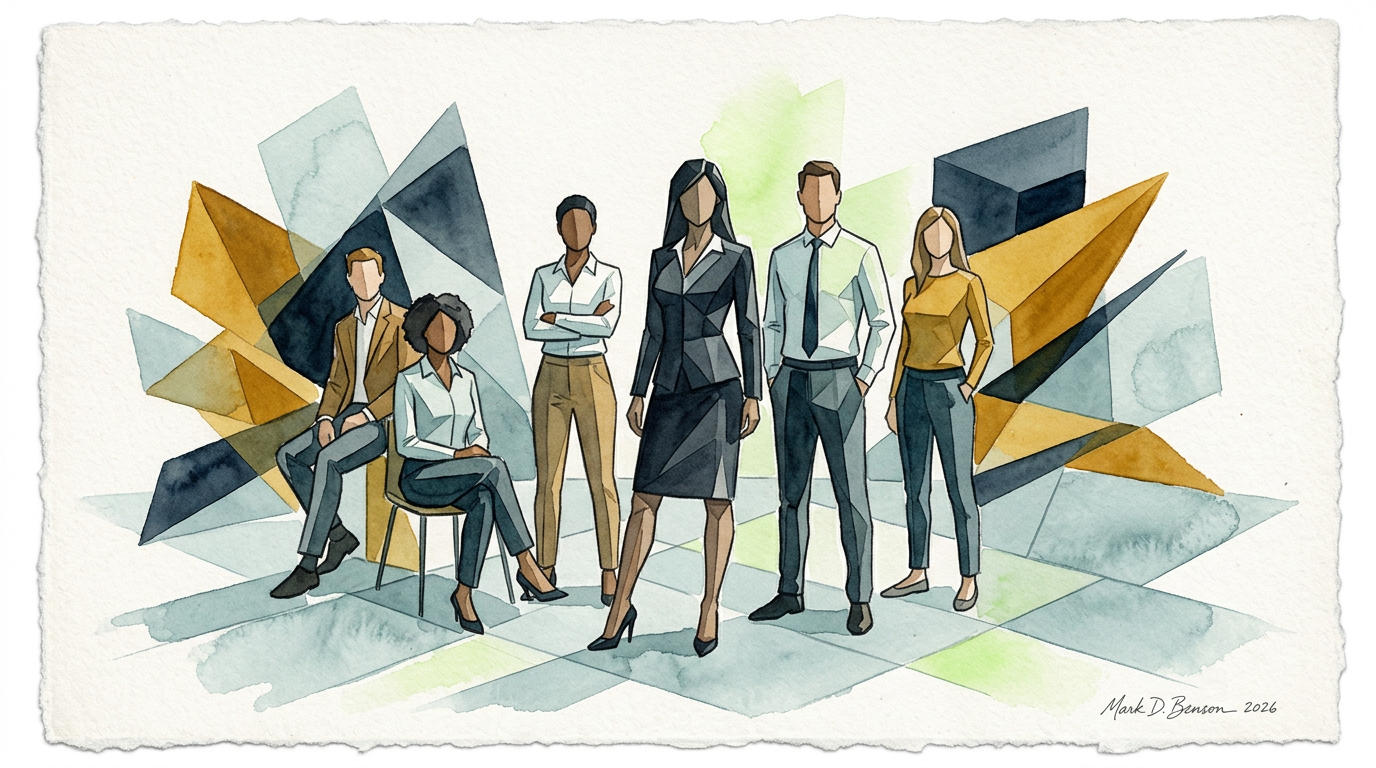
A shared reflection guide to help teams notice how pressure is shaping communication, trust, and collaboration.
Pressure does not distribute evenly across a team. The same deadline that sharpens one person makes another cautious. The same ambiguity that energizes one group leaves another waiting for permission. Over months those individual responses harden into how the team communicates, decides, and trusts one another, and almost none of it gets decided in a meeting.
That is the difficulty. A team under sustained pressure does not announce that it has changed. It adapts, each adaptation is locally reasonable, and the sum of them becomes the new normal before anyone has words for it.
Most teams that struggle are not short on effort or intent. They are operating inside a system that pressure has reshaped, and nobody has named the reshaping out loud.
Behavior changes before results do, which means the earliest evidence is available to you now, in rooms you are already sitting in. Six signals are worth watching, and each one indicates something specific.
Decisions are getting made faster, with less discussion. This reads as improved execution and is often the first sign of the opposite. A team under pressure narrows the set of options it considers, because considering more takes time it does not feel it has. Speed rises. The quality of the reasoning underneath falls. Neither movement shows up on a dashboard, which is why this one runs the longest before anyone catches it.
People stop raising concerns as a deadline approaches. Not because they have none. Because raising one has become expensive, and the expense lands on the person who raises it. The risk does not disappear when this happens. It gets absorbed somewhere less visible, usually inside an estimate.
Ownership blurs. Under pressure more decisions get made by groups, and groups decide slower and own less than individuals do. When you cannot name who decided something, you have found a place where pressure has already changed your operating model.
Alignment gets assumed rather than checked. Checking costs a conversation, and under load teams skip it. The gap surfaces later, almost always at the seam between two functions, where nobody was quite responsible for noticing.
Workarounds are increasing. A workaround is information about the system rather than about the person taking the shortcut. It says the official path has become too slow or too costly to use, and someone made a rational choice about that.
Fatigue is present and does not get discussed. The absence of the conversation is the finding. In most organizations, saying you are tired is heard as saying you are not capable, so people carry it privately until the day they resign.
It is easy to read the list above as a set of feelings, and to file it under morale. That reading is comfortable and it is wrong, because each signal has a cost that shows up in places your leadership team already watches.
Decision quality falls while decision speed rises. A team that has narrowed its options is faster and more decisive at exactly the moment it is deciding against an incomplete picture. You will not see this as a problem. You will see it as improved execution, right up until a decision made in seconds turns out to have needed the conversation.
Work at the seams degrades first and reports last. The parts of the work that crossed a boundary belonged to no single function and were visible to few people. When alignment stops getting checked, those are the parts that fall through, and they fall through without generating a ticket.
Your capacity model stops describing reality. Coverage that nobody wrote down commits real hours against nothing on paper. You then plan the next quarter against a number that assumes those hours are free, prioritize confidently against it, and discover the gap months later as slipped commitments that get blamed on estimation.
Discretionary effort closes before compliance does. Most of what an organization calls excellence lives in the margin beyond what was asked: the catch nobody assigned, the second look at work that already passed review, the hard conversation someone starts because they care about the outcome more than the awkwardness. That margin is the first thing to close under sustained pressure, and it closes without an argument. Output holds for a quarter or two afterward, which is exactly why this gets expensive before it gets noticed.
The instinct, once a team sees this list, is to reduce the pressure. That instinct is right about a third of the time and it makes the other two thirds worse.
Sort what you are carrying into three categories before you touch any of it.
Pressure to reduce. Load that is draining energy and narrowing judgment without buying anything. This is the pressure that should come off, and taking it off is straightforwardly good.
Tension to normalize. Discomfort that is doing real work: the disagreement that surfaces a flaw, the constraint that forces a better design, the deadline that ends a debate which was not converging. Removing this makes a team feel better and perform worse.
Pressure to elevate. Load that is pointing at something the team has been avoiding. Here the correct move is not to reduce it but to name it and put it in front of people, because the discomfort is the signal.
Teams that skip this sorting step tend to eliminate the tension they should have kept, because it is the easiest kind to remove, and leave the pressure that is actually costing them, because it is attached to something important.
Includes the full guide library and your Pressure Signature report.
Mark D. Benson is the founder and principal writer of Resonant Vector™, the home of Pressure Intelligence™, and the host of Pressure Rising™. He is a senior executive, product and systems leader, and writer.
In his professional role, Mark leads SmartThings at Samsung, working at the intersection of strategy, technology, and large-scale human systems. His experience spans global teams, complex platforms, and environments where sustained pressure and high stakes are the norm.
Resonant Vector™ is an independent initiative, separate from his corporate role and not affiliated with Samsung or SmartThings. It reflects a personal commitment to learning in public, sharing practical insights, and contributing to healthier leadership practice over time.
More about Mark can be found at markdbenson.com.