email@email.com
On the force that breaks what it touches, why the fix is rarely shrinking the weight, and what it takes to widen the surface that carries it.
Behind my house in Minnesota there are several acres I have crossed more times than I can count, part farmland, part marsh, part forest. In deep winter it turns into one smooth white field. But that smoothness is deceptive. The ground underneath keeps rising and dropping, so the depth changes step to step without telling you. One stride holds. The next finds two feet of loose powder over a low spot, and in you go. Boot, shin, thigh. There is a name for this effect: post-holing. In boots, even good warm ones, it had me winded a hundred yards into my own back yard.
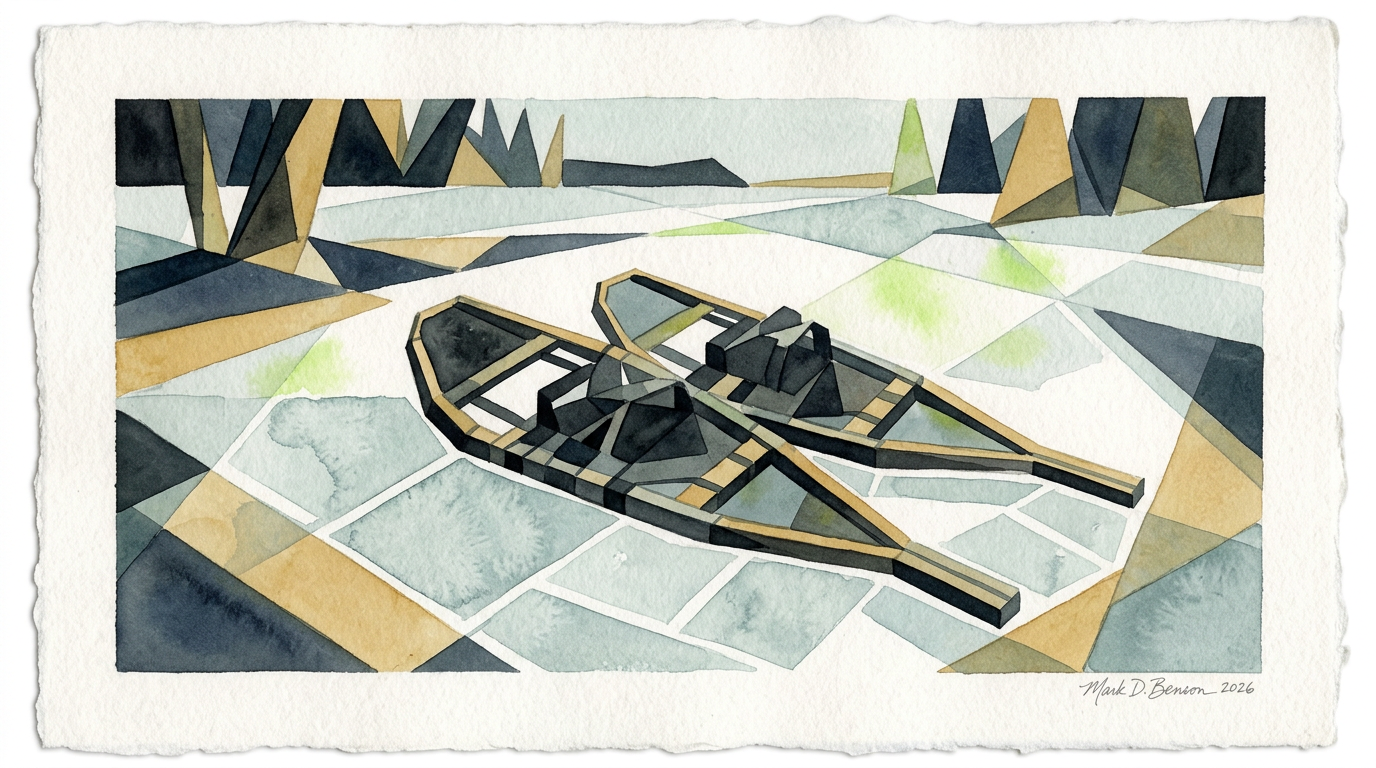
Then I got a pair of snowshoes, and the same ground stopped swallowing me. Same person. Same weight. Same snow. I walked several miles over drifts that used to take me to the thigh. Not easily. Every step still cost far more than it would on bare ground, and I came back tired. Easier is not the same as easy. But the snow stopped winning. Nothing about me had changed. The only thing that changed was the span of the surface under my weight. It is not a trick. It’s physics.
For years I got this exact lesson wrong at work. When someone on my team was sinking, I reached for the only two tools I could see: lighten the load, which I couldn’t always control, or encourage them to take a short vacation and then grind it out until the end of the surge. Neither of those approaches touched the real problem, which was how few square inches sat under the load.
Pressure = Force / Area
In physics, pressure is defined as force per unit area. That’s only two variables, so pressure rises in two ways:
Teams are not physics problems, but this formula has changed my first question about any hard season for a team. Not how heavy. How wide.
Snowshoe weather is my name for the seasons most teams actually work through: the load is deep, there is no route around it, and the formula’s two variables are the whole diagnosis. When a heavy force lands on a team and the surface is a few people, it becomes acute pressure on those few. Kept connected and spread wide, the same force becomes a weight the whole team can carry together. And connection is the part that makes it work. A snowshoe is not a plank. It is a frame laced with webbing, dozens of small connections sharing every step. A team is the same: the tight network of people and processes is what makes the area wide, and a load carried that way is not just lighter per person. It is steadier, higher quality, and much harder to drop.
But load does not spread itself. Under strain, work flows toward whoever can carry it: escalations route to the person who fixed it last time, knowledge pools in whoever has been there longest, approvals queue behind the one name everyone trusts. Competence attracts load, so the reward for carrying well is more to carry. From above it looks like efficiency. The org chart reads smooth, like the field behind my house; a load map would show two or three people under most of the weight. The tell is where work waits: progress queued behind one calendar, a vacation that requires a war plan, “only one person knows how” said as a fact instead of a warning. The one carrying the most is the first to punch through.
Most of us inherited instincts that aim at the wrong variable. Reduce the force: sometimes possible, rarely ours to decide. Toughen the person carrying it: that is buying stiffer boots for deep snow. The boots don’t change what the snow does. Only the snowshoe does, because it never argues with the weight. It simply spreads it out.
What blocks the fix is that widening looks wasteful up front. A snowshoe looks absurd on a hardware-store wall, all that frame for one foot; a second trained hand on the billing system reads the same way in a budget review, right up until the week it doesn’t. Widening charges you this sprint and pays you back all year; the cost is visible, the benefit never announces itself. The person under the point rarely asks for it either: carrying a heavy load alone can be attached to identity, pride, sometimes job security, so the concentration ironically can end up protecting itself.
The reframe is narrow, and it is available at every level. You rarely control the force. You almost always control some of the area: who else can do this, who else knows this, who else may decide this, who else can support the person or team carrying the heaviest load? If force is what happens to you, area is what you can build in response.
Four moves. None needs a reorg, and none needs permission from the level above you.
Map the point loads. You cannot widen what you cannot see. List what only one person can do. Note where approvals wait on a single name, which system has one keyholder, and where work naturally concentrates, not where the process says it lands. One page. Every time I have drawn it, it has surprised me. Concentration is emergent: nobody decided it, so nobody has seen it whole.
Widen the surface. Part of widening is mechanics. Delegate the heaviest work across more people instead of letting it pool where it always pools. Ask for help. Stretch a work stream across more time when the calendar allows. Put a second trained hand on the critical system, write the runbook, push a decision down a level, rotate the job no one can put down. Cross-training research backs the mechanics: teams trained across roles coordinate more smoothly and back each other up more.[1]
Stay connected. The other part is staying connected while you carry. Pressure isolates: heads drop, doors close, everyone retreats to their own piece, and isolation turns a wide team back into a set of separate boot prints. Connected teams do the opposite. They watch where the force is highest this week and shift hands toward it. They watch each other for the early signs of burnout and step in, or advocate up the chain for relief, before the punch-through. And when you are the one sinking, raise your hand. It can feel like weakness, even shame. It is neither. Toyota built that truth into its factories decades ago: a cord runs the length of every production line, and any worker who spots a problem can pull it. Help converges within moments. No one asks whether the worker should have handled it alone. Asking for help is what a high performing system does. It is not a character test.[2]
Reward the spread, not the save. The all-nighter that rescues the launch gets applause. The cross-training that made it unnecessary gets a line-item review. Researchers have documented that trap for decades: organizations reward visible firefighting over invisible prevention, and get more fires.[3] What you celebrate, you concentrate. So celebrate the spread: the clean handoff, the covered vacation, the week the keyholder was gone and nothing broke. Say out loud that the boring week was bought, and name who bought it.
Mark D. Benson is the founder and principal writer of Resonant Vector™, the home of Pressure Intelligence™, and the host of Pressure Rising™. He is a senior executive, product and systems leader, and writer.
In his professional role, Mark leads SmartThings at Samsung, working at the intersection of strategy, technology, and large-scale human systems. His experience spans global teams, complex platforms, and environments where sustained pressure and high stakes are the norm.
Resonant Vector™ is an independent initiative, separate from his corporate role and not affiliated with Samsung or SmartThings. It reflects a personal commitment to learning in public, sharing practical insights, and contributing to healthier leadership practice over time.
More about Mark can be found at markdbenson.com.