
email@email.com
On what strain reveals rather than creates, how stories become culture, and why the watching matters more than the words.
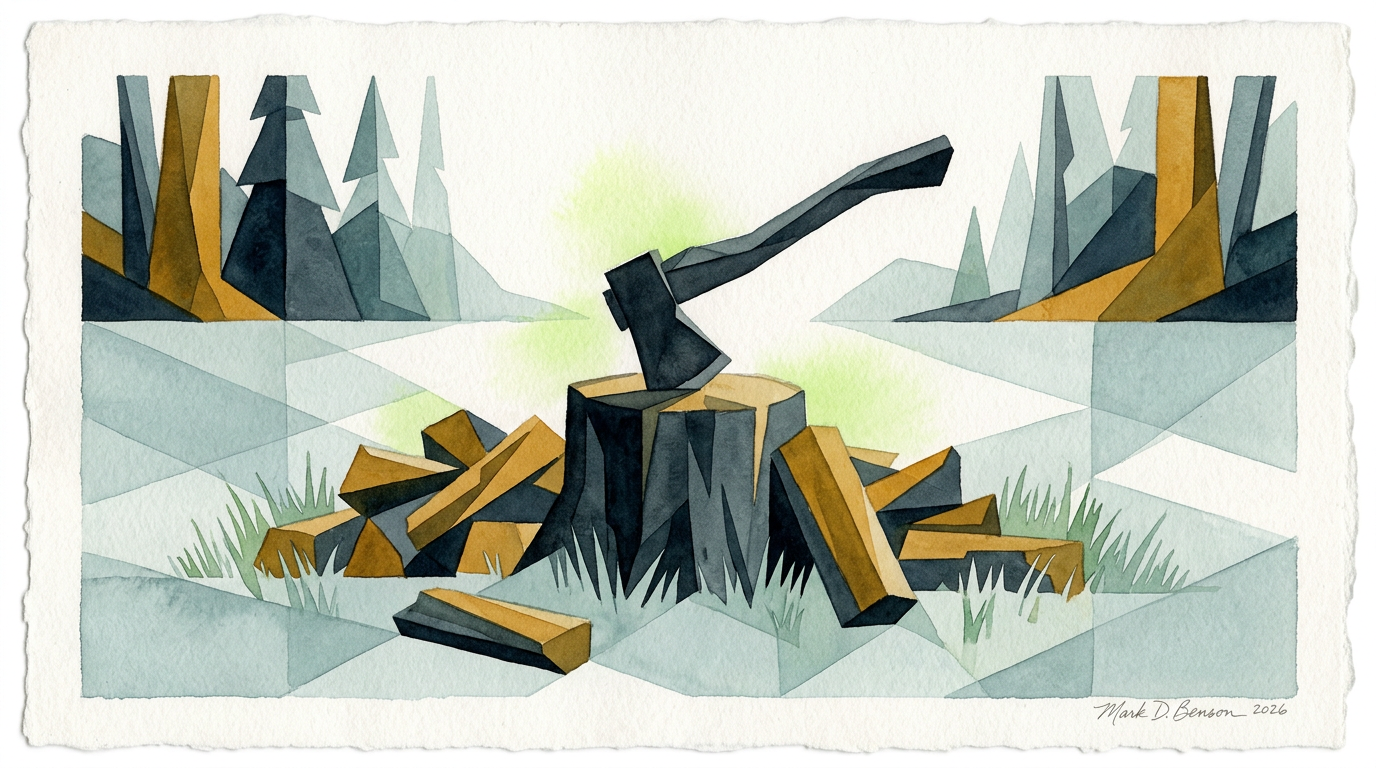
I split firewood most falls. It is a chore I have never wanted to make efficient: a maul, a stump, a few cold October afternoons in Minnesota. And a maul is a patient teacher. You do not choose where the log splits. You can aim, you can swing harder, but the wood opens along lines laid down years before you picked it up, ring by ring, season by season, while the tree was still standing. On the surface, one board looks much like another. Load is what shows the grain.
I used to believe culture worked the other way, that it was something you could write. I had the artifacts to prove it: a values page I was proud of, built in two days of workshops and wordsmithed to the comma. What changed my mind was hearing one of my own decisions come back to me as a story.
The decision itself felt small. Two days before a date we had promised to customers and to the level above me, one of our engineers found a defect. Not a cosmetic one. Under a narrow set of conditions, the upgrade would corrupt data for a small slice of customers. The room did the math out loud: the date was public, the fix was roughly a week, the odds were low. I said we would take the week and I would deliver the news myself. It did not feel like leadership in the moment. It felt like an expensive Tuesday, and within a month I had mostly stopped thinking about it.
More than a year later I heard the moment again, from someone who had not been in the room, explaining to a new hire how the team worked. The details had been sanded smooth. The defect had grown in the telling. My part had been compressed into a single line I do not remember saying: we don’t ship broken things to people who trust us. The story was maybe sixty percent accurate, and the lesson had survived at full strength.
Nobody ever retold the values page. They retold the decision. And what stayed with me afterward was not pride. It was the math. I had made dozens of decisions under strain in those years, and I only got to hear the one story that happened to reach me. The others were circulating somewhere too.
True grain is my name for what a hard season shows you: what a team actually believes, revealed in the decisions that strain forces into the open. An easy quarter keeps values comfortable, because nothing asks them to compete with each other. Strain is what finally stages the collision: quality against the date, candor against the schedule, the person against the plan. And whichever value wins that collision, in front of people, becomes the culture the team actually has, no matter what got written down in better weather.
The collision always has an audience. Teams watch decisions made under load with an attention no all-hands ever earns, because that is where the real rules get published. People do not need to experience consequences to learn them; watching someone else is enough.[1] Nobody on your team needs to personally test whether it is safe to flag a defect two days before a launch. Someone tested it once, and everyone else learned from what happened next, or from the story about what happened next.
The story is the second mechanism, and the more durable one, because culture’s storage format is narrative. Researchers who set out to catalog organizational stories kept finding the same handful of plots doing the heavy lifting, in organization after organization, each convinced its stories were unique.[2] A hard decision gets compressed to a sentence, loses its qualifiers, gains a moral, and outlives everyone’s memory of the actual week. Edgar Schein put a leader’s visible reaction to critical incidents on his short list of how culture actually gets embedded, and the official statements sit on his other list, the reinforcing one, where they can only reinforce what the incidents have already taught.[3]
The tell is easy to find. Listen to what gets retold: what a new hire hears at lunch in the first month, which old moments surface in retros as shorthand. Those stories are the operating culture, whatever the wall says.
Two instincts get in the way here, and they fail in opposite directions.
The first treats culture as a writing project: choose the values, publish them, repeat them until they stick. The words are not useless, but a value that has never cost anything in public remains a hypothesis to the people watching, and no amount of repetition promotes it to fact. What promotes it is a decision under strain that visibly paid for it. The writing is only ever a draft; the deciding is what publishes it.
The second instinct misreads the reveal. When a hard stretch surfaces behavior a leader does not like, corners cut, blame moving faster than information, the comfortable read is that strain made the team worse and that easier weeks will restore them. There is a real half to that, because sustained load erodes judgment before it erodes effort, and tired people make sloppier tradeoffs. But strain does not invent values. The shortcut a team reaches for under load runs along lines that were already there, grown from what has been rewarded, what has been tolerated, and which stories got retold. The load picks the moment. The grain picks the direction.
Read that way, a hard week is not only damage. It is a reading you could not have gotten any other way, an accurate look at the grain the team has actually grown, as opposed to the one on the poster. The urge to explain it away is strong, because the reveal implicates the slower weeks when that grain was being laid down, and nobody enjoys that arithmetic. It is worth resisting the urge long enough to take notes.
The grain is also still growing. A tree only adds rings while it is alive, and a team adds one every season, decision by visible decision. You cannot rewrite the rings already laid down, but you can decide what the next one records. And that work is not reserved for whoever owns the values deck, because the stories that govern daily behavior are mostly local, about someone a desk away or one level up, not the CEO. If five people can see your decisions, you are writing culture for five people. The moments are already yours.
Four moves follow from this, and none of them needs a culture initiative or your name on the values deck.
Choose your lines before the strain does. Under load you will default to the grain you have already grown, which makes the middle of a crisis the wrong place to discover your standards. Pick a steady week and name the one or two lines you intend to hold when they get expensive: what does not ship, what does not get skipped, who does not take public blame for a system problem. Name them early, because a line announced ahead of the strain carries the authority of a standard, and the same line improvised at eleven at night sounds like a mood.
Say the why while you decide. The story of the decision will be written with or without you, and the only part you control is the quality of the raw material. One sentence usually does it: the tradeoff, the cost, who carries it. “We are taking the week’s delay, and I will own that conversation” survives retelling nearly intact, while a decision that ships without a why gets its motive assigned by whoever tells the story first. This is not spin. Spin manages the story instead of the decision; narration just makes the decision legible while it is happening.
Name exceptions as exceptions. Some weeks the tradeoff genuinely goes the other way, and a line you meant to hold bends. The damage is rarely the bend itself but the unnamed bend, because a story never carries the caveats you did not say out loud. Say what made this time different and what stays true, and the exception stays an exception. Skip that sentence and it arrives in next year’s retelling as precedent.
Retell the moments you want repeated. Somewhere near you, someone held a line under load last quarter and paid something for it. Tell that story, with the name and the cost attached, because retelling is the one lever on the story side that is entirely yours. What gets retold gets repeated.
Mark D. Benson is the founder and principal writer of Resonant Vector™, the home of Pressure Intelligence™, and the host of Pressure Rising™. He is a senior executive, product and systems leader, and writer.
In his professional role, Mark leads SmartThings at Samsung, working at the intersection of strategy, technology, and large-scale human systems. His experience spans global teams, complex platforms, and environments where sustained pressure and high stakes are the norm.
Resonant Vector™ is an independent initiative, separate from his corporate role and not affiliated with Samsung or SmartThings. It reflects a personal commitment to learning in public, sharing practical insights, and contributing to healthier leadership practice over time.
More about Mark can be found at markdbenson.com.